terça-feira, 22 de junho de 2010

EXCHANGE RADICAL MOMENTS!


Brandnew Europe Wide Live Art Festival


Exchange Radical Moments! is a brand new Europe-wide festival. It will take place simultaneously in cities across Europe – in Italy, Germany, the Czech Republic, Macedonia, Latvia, the UK and Austria, among others on 11 November 2011 (11.11.11), showing site-specific interventions, public interventions, performances and live acts. It is the first time that such a festival takes place simultaneously across the continent.

An Open Call will invite artists to present ideas for projects along with a short biography by September 30, 2010.


The period between this open call and the events and actions that will take place on 11 November 2011 forms the ‘exchange phase’ of the project.

Calling for Ideas
Send us now your sketchy project ideas to moments (at) fabrikanten till 30.09.2010. Please, also include a short biography, more details on the Open Call

More on
EXCHANGE RADICAL MOMENTS!

Pdf
Exchange Radical Moments!

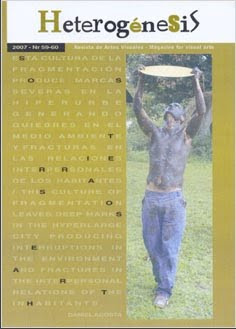
HETEROGÉNESIS 59-60


La expresión más recurrente es la acción e intervenciones fugaces en el entorno. No hay alta tecnología involucrada, sencillamente un diálogo respetuoso con el entorno, un ritual de encuentro con lo esencial.


Dedicamos este doble número de Heterogénesis a este proyecto artístico que ya tiene tres ediciones (2005, 2006 y 2007) y que se puede considerar como un proyecto en desarrollo. Publicamos el diario del proyecto escrito Daniel Acosta en el que va presentando las distintas etapas del proyecto. Martin F Yriart reflexiona sobre el arte performático como comunicación ecológica y su relación con la concepción contemporánea de la ciencia. Clemente Padín presenta las acciones realizadas en el parque ecológico Hudson en la última edición del proyecto conectándolo con la performance como género y el problema ambiental que vivimos. Vicente Zito Lema escribe en torno a las paradojas sobre la dignidad de la vida (el crimen de las guerras por un lado y el “mito” de los derechos humanos por el otro), la pobreza (la riqueza como fin en sí extremada por la ley del mercado y el crimen de la pobreza) y el socorro de la tierra (el peligro de la muerte de la tierra y la necesidad del depertar de conciencias). Finalmente incluimos documentación de las dos acciones que el grupo Limes de Escania ha realizado respondiendo al llamado de Daniel Acosta. Común a todas las contribuciones de esta revista es lo que argumentaba Al Gore en su documental: la conservación del medio ambiente es una cuestión moral.

Ximena Narea


Sitio web del proyecto

http://www.heterogenesis.com/SOSTierra.htm


Pdf Heterogénesis 59-60


The most frequent expressions are the ephemerae actions and interventions. There is no high level of technologi involved, it is simply a respectful dialogue with the surroundings, a ritual of encountering the essential.


We dedicate this double issue of Heterogénesis to this artistic project which already has three editions (2005, 2006 and 2007) and can be considered a project in progress.

We publish Diary of the Project written by Daniel Acosta, in which he explains the different phases of the project. Martin F Yriart reflects on the performance genre as ecological communication and its relation to the contemporary conception of science. Clemente Padín describes the actions realized in the ecological park Hudson in the last edition of SOS Tierra and connecting the event to the performance genre and the environmental problems we are experiencing now. Vicente Zito Lema writes about the paradoxes and the dignity of life (the crimes of war on one hand and the “myth” of human rights on the other), poverty (richness as an aim in itself in spite of the market laws and the crime of poverty) and the call for help by Earth (the danger of Earth dying and the need to the awakening of the conscience). Finally we show some

documentation from the two actions performed by the group Limes realized in Scania in answer to Acostas’ call. What is in common for every contribution we are publishing in this issue of Heterogénesis is what Al Gore agues in his documentary: to preserve the environment is a moral question.

Ximena Narea


terça-feira, 15 de junho de 2010

FESTIVAL SILÊNCIO 2010 - Goethe Institut

GIBBERISH

Performance duracional por Manuela São Simão e Pedro Lopes, com a colaboração da equipa da Rádio Zero.

16 Junho [performance das 18h30 às 20h30 - jardim e auditório]

22 Junho [Instalação das 18h às 20h - auditório]


FESTIVAL SILÊNCIO 2010 - Goethe Institut em Lisboa

[Jardim dos Sons]

A performance duracional Gibberish foi desenvolvida especificamente para a proposta do Jardim dos Sons, inserido no Festival Silêncio no Instituto Goethe em Lisboa.

Relacionam-se espaços físicos e mentais: o Jardim e Auditório do Instituto, locais distintos e disjuntos, que aqui se interligam através de um percurso proposto entre a improvisação in loco do músico no Jardim, e a (re)acção ao mesmo som numa escrita caligráfica e plástica realizada pela artista visual, no espaço isolado do auditório.

O som improvisado é audível através de rádios distribuídos ao público à entrada do Instituto, produzindo, no jardim, uma camuflagem sonora cuja descontextualização do seu laboratório-jardim, assume o carácter acusmático de um som pensado para ser transmitido em rádios low-fi, característica enfatizada na possibilidade de escuta no espaço indoors do auditório, sob uma certa penumbra.

Isolada do espaço orgânico e da luz do jardim, Manuela São Simão, improvisa uma escrita silenciosa durante duas horas. Um motor montado num pequeno dispositivo-mesa-de-trabalho é programado para uma determinada cadência temporal. A artista intervém e (re)age a partir do som que vai recebendo directamente do músico.

Compondo em tempo real a partir dos sons orgânicos do jardim, das gravações de campo feitas em diversas zonas urbanas da cidade de Lisboa e principalmente das gravações realizadas durante aulas da língua Alemã leccionadas no instituto, o músico Pedro Lopes processa tudo isto compondo um som contínuo, por vezes mais musical, com momentos em que a língua alemã e suas sonoridades específicas são processadas ao ponto de uma certa abstracção, mantendo as suas características estéticas que nos faz reconhecer a língua como tal, mesmo sem por vezes perceber o que está a ser comunicado.

Para ver e/ou ouvir, o desenrolar de um inventário de sons orgânicos e humanos, que pode ser escutado nos vários espaços exteriores e auditório e através de rádios, com a colaboração da equipa da Rádio Zero na criação e transmissão de uma onda micro FM local.

_____________________________

http://festivalsilencio.com

http://www.goethe.de/portugal

http://www.radiozero.pt

Goethe-Institut Portugal
Campo dos Mártires da Pátria, 37
1169-016 Lisboa
21 882 45 10 | info@lissabon.goethe.org

segunda-feira, 14 de junho de 2010

CONTENTORES


INAUGURAÇÃO | 5ª FEIRA | 17 DE JUNHO | 21H00

Luisa Cunha e Bruce Nauman
Uma Performance e uma conversa

A performance foi iniciada a 20 de Março de 2010, às 19h32.
A conversa terá início no dia 17 de Junho de 2010 à hora da abertura do projecto Luisa Cunha e Bruce Nauman vão estar neste projecto em conversa, numa performance cujo resultado estará patente na face de dois contentores.


LUISA CUNHA & BRUCE NAUMAN
One performance and one conversation

The performance took place on March 20, 2010, at 19h32.
The conversation will take place on June 17, 2010, at the project’s opening time.
Luisa Cunha and Bruce Nauman will converse as part of a performance whose result will be exhibited in two containers.

Fernando Ribeiro
Tell me My Name

Tell Me My Name é uma performance executada pelo artista em dois contentores de carga marítima. Dela ficarão vestígios materiais e sensoriais, vestígios esses que remetem para questões relacionadas com a sensualidade e a identidade, e ainda para a (in)determinação sexual,
que decorre quer do facto de ambos os contentores terem a mesma iluminação, quer da informação presente nos vestígios deixados após a realização da performance.

Fernando Ribeiro
Tell Me My Name

Tell Me My Name is a performance undertaken by the artist in two shipping containers. It will leave behind material and sensorial traces which evoke themes related to sensuality and identity and also sexual (in)determination, deriving not only from the fact that both containers have the same lighting, but also from the information enclosed in the traces left by the performance.

www.contentoresp28.com
VIDEO
Comunicação: 28 Comunicação
Email: prod.p28@pavilhao28.com

sexta-feira, 11 de junho de 2010

Gesture & Trace


Gesture & Trace

Rochelle Haley


16 – 26 June 2010
PROGRAM
Open Residency: 16 – 19 June; 23 – 25 June 2010

Wednesday to Saturday, from 19h to 23h, Drawing Spaces


Performance/ Project Presentation/ Opening:

26 June 2010, 21h, Drawing Spaces


Speakers:

Nuno Oliveira, Fabrice Ziegler, Margarida Chambel and Carlos Farinha

(Coordinators of the project ‘Epipiderme – Encounters around performance’)


Gesture & Trace
In a collision between dance and drawing, the movements of a dancer are transformed into a series of lines drawn live by the artist (Rochelle Haley). Drawing with both hands simultaneously, the artist tracks the movement of two points on the dancer’s body. The drawing is filmed from above and is projected onto a wall via a live feed. Other dancers then use the drawn lines as visual cues to interpret their own movement.

‘Gesture & Trace’ investigates drawing as an embodied and performance based activity. The methodology, maintaining a direct material interaction with the drawn line, explores relationships between the visual graphic mark and dance-based motion. The experimental pairing of dance and drawing provides space to explore complex and figurative interactions between the visual and performing arts. At the heart of this project is the reciprocity between the body, motion and line.


Rochelle Haley is a Sydney based artist working with experimental drawing, installation and performance. She completed a PhD at the College of Fine Arts, UNSW. Haley has held several solo exhibitions and has exhibited widely in group shows in Australia, China, Malaysia, Pakistan and Turkey. Haley’s work is included in several public collections including the NSW Attorney Generals Department. Recently Haley has been artist in residence at Bundanon, NSW; Creative Paper, Tas; Rimbun Dahan, Malaysia; Cite Internationale des Arts, Paris and Performing Arts Forum, St Erme, France. During 2009 Haley initiated a drawing-based performance collaboration with dancers from ASWARA performed in Kuala Lumpur Jan 2010. An ongoing investigation of this method with Swiss choreographer Marion Ruchti began in Paris in April 2010.
www.rochellehaley.com


Epipiderme – Encounters around performance’
Nuno Oliveira, Fabrice Ziegler, Margarida Chambel and Carlos Farinha
http://epipiderme.blogspot.com/


Drawing Spaces, Fábrica Braço de Prata
Rua da Fábrica do Material de Guerra, nº1, 1950 – 128, Lisbon
Near the riverside, next to ‘25 de Abril’ Plaza (roundabout), just before the ‘Expo’ area entrance
Bus: 28; Train Station: Braço de Prata (Connecting stations: Entrecampos, Roma, Sta. Apolónia).
Public Schedule: Wednesday – Saturday, from 19h to 23h

Website: www.drawingspaces.weebly.com Email: drawingspaces@googlemail.com
Facebook: facebook.com/drawingspaces.espacosdodesenho

segunda-feira, 7 de junho de 2010

PAF SUMMER UNIVERSITY 2010


SUMMER UNIVERSITY, july 30st - august 8th 2010


PAF SUMMER UNIVERSITY 2010

PerformingArtsForum, St. Erme, France www.pa-f.net

The «Universities» at PAF are a project initiated in the year 2005 by a number of artists, theoreticians and practitioners during the initial meeting in PAF. The «Summer University» [SU] in August 2010 is the seventh «University» project organized in the building in St Erme.

The main interest of SU10 is to experiment with and to test the practices PAF is developing and will develop in future: areas of research, modes (methods, procedures, techniques) of production, frames of collaboration, types of projects, discursive engagement by all interested participants. In a few words: all activities that make up knowledge production in the arts, theory and cultural practice, open and specific.

«University» and participation «University» is the term that replaces «Academy» referring to the Renaissance principle of combining research and education in one location. Secondly, it is called «University» because PAF will be open to all areas of knowledge, even though art is the starting point. SU10 isn’t another international summer academy, offering workshops, lec- tures, panels etc. under a representative topic for which participants apply. The participants of SU10 are at the same time its organizers, in that they are proposing, organizing, and taking part in different projects and activities during SU09. In contrast to existing academies SU09 isn’t based on the principle of «pay to learn and teach to earn». Every participant pays the same fee (the equivalent of food, lodging and technical organization) to take part, no matter what competence or specific knowledge he/she can offer. The access to SU10 is open, but more specifically determined by each project/activity. The aim behind the open access and self-organization is to enable parallel heterogeneous research platforms, to experiment with configurations, extensions, transformations, interferences, mergings and forkings of projects/activities.
Preparation & Programme Everyone is invited to propose the project or activity he/she would like to organize within SU10. The only limit of choice is the capacity of the house.

During the SU10 have a cook then, and those days we supply the food (obligatory) 3 meals plus coffee/tea and wine, for 17 euro a day.
This is above the room price of 13 euro per night, so 30 euro a day, during SU10.
Before or after the SU period you only pay the 13 euros per night per person when you stay longer than 5 nights. less than 5 nights the price per person is 15 euro.

From January 2010 on we will introduce an obligatory membership of the association PAF for everybody who stays at paf, for security reasons, of 12 euro membershipfee for one full year. This is above the price for the room . Apart from how often one stays at paf one pays only ones per 12 months for the membership.

How to become a participant? It’s as easy as sending an email with or without a proposal to Jan Ritsema:janritsema@mac.com

PAF is a open and relatively free site (and)
PAF is a nomadic space
PAF tries to stay cheap
PAF has almost no staff
(When PAF would have a staff, the prices would be much higher and the highly appreciated autonomy offered to the participants now would be strongly limited. PAF would no longer make a difference but would become a normal well organised artists residency, where space and material belong to the staffs responsability.)

The highly appreciated autonomy can only be maintained when everybody takes part in the every day maintenance organisation.
In other words: -Don’t leave traces and put things back where you found them.
To be more concrete: - clean up the personal and general dirt you left behind you. - do not colonize space nor information (books, dvd’s etc.), - and keep information, materials, apparatuses and spaces available and moveable.
To say it differently: Make it possible for others, not by retreating, not by withdrawel, or by being modest, on the contrary, making it possible for others is thought as active participation. Through action one offers and opens spaces in which others can take part. One proposes participation in an open rehearsal, a lecture, a conversation, a film or documentairy showing and/or by cleaning up and maintening general space.
In other words: one does. This makes that the doer decides at PAF.

Contact & Information Jan Ritsema / PAF | 15, rue Haute | F-02820 St Erme Outre et Ramecourt T/F +33323801846 | mobile: +33642806901 email: janritsema@mac.com | skype: janritsema | www.pa-f.net

terça-feira, 1 de junho de 2010

THE INVISIBLE MAN


Data:
quinta-feira, 3 de Junho de 2010
Hora:
20:00 - 21:00 (France)
Local:
La rigueur n'est pas une valeur sûre -Cycle d'exposition- Saint Etienne

/////Português/////

Procuramos colaboradores para participar numa proposta de performance para internet:


O HOMEM INVISÍVEL

Ideia:

Esta proposta será apresentada no ciclo de exposições organizado pelo artista plástico e director artístico Antoine Reynaud com o título La rigueur n'est pas une valeur sûre, em Saint Etienne, no dia 3 de Junho de 2010.
http://larigueurnestpasunevaleursure.blogspot.com/

Das 20h ás 21h, na hora local em França, nesse espaço, estará uma pessoa sentada a cortar as unhas ao público, uma manicure de vestido de noite, e uma segunda pessoa, um construtor civil a pintar uma parede de branco. Um terceiro elemento que estará visível neste espaço será uma impressora.

Quem está a cortar as unhas vai varrendo esses restos para o centro da galeria, enquanto a outra pessoa continua a pintar a parede de branco.

A uma dada altura a impressora começará a funcionar:

Para a realização da acção necessitamos a colaboração de quem estiver interessado em enviar por email registos em papel branco com restos de unhas, cabelos ou qualquer outro elemento orgânico do corpo humano.

A proposta é: fazer qualquer tipo de intervenção sobre papel branco A4, com matéria orgânica humana, passar por scanner esse material e enviar para o e-mail, sincronizando os participantes à mesma hora, com a performance ao vivo.

Na folha deve ter o nome do participante a hora e o local de onde é enviado.

Estas folhas vão sendo instaladas no chão à volta das unhas do público da galeria, criando composições e relações entre o que está a acontecer lá e as acções invisíveis de cada participante.

Agradecemos que nos comuniquem se quiserem participar:
-De maneira a que os vossos nomes constem do material de divulgação
-Para marcar as horas em cada um vai participar conforme o país de origem

Nuno Oliveira e Margarida Chambel, com a colaboração de: Mau Mar Yor, Fausto Grossi, Rocio Boliver, Teresa Huertas, Aisa Boaa, Tzitzi Barrantes...(?)

O e-mail da Galeria em Saint Etienne para qual se deve enviar o material:
galerie_nspp_42@yahoo.fr


/////Español/////


Se necesitan colaboradores para participar en una performance vía internet:


EL HOMBRE INVISIBLE

Idea:

Esta propuesta será presentada en el ciclo de exposiciones organizado por el artista plástico y director artístico Antoine Reynaud, titulado: La rigueur n'est pas une valeur sûre, que se celebrará en Saint Etienne, el dia 3 de Junio de 2010.
http://larigueurnestpasunevaleursure.blogspot.com/

Desde las 20h hasta las 21h, hora francesa, estará, en el espacio de la galería, una persona preparada para cortar las uñas al público, hará la manicura con un vestido de noche. Una segunda persona, un constructor civil, pintará una pared de blanco. El tercer elemento que estará visible en este espacio, será una impresora.

Quien corta las uñas irá acumulando los restos en el centro da galería al tiempo que la otra persona continua pintando la pared de blanco.

En un momento dado la impresora comenzará a funcionar:

Para la realización de esta acción necesitamos la colaboración de quienes estén interesados en enviar por email los registros, sobre papel blanco, de restos de uñas, cabellos o cualquier otro elemento orgánico del cuerpo humano.

La propuesta es: hacer cualquier tipo de intervención sobre papel blanco A4, con materia orgánica humana, scannear el material y enviarlo por e-mail. De esta manera se sincronizan los participantes con la performance en vivo.

La hoja o el folio, deben llevar el nombre del participante, la hora y la localidad desde donde es enviado.

Estas hojas van siendo instaladas al tiempo que lo son las uñas del público de la galería, creando composiciones y relaciones entre lo que acontece en la galería y las acciones invisibles de cada participante.

Agradeceríamos que nos comunicasen la participación:
-De manera que sus nombres consten en el material de divulgación
-Para marcar las horas en las que cada uno va a participar conforme el país de origen

Nuno Oliveira e Margarida Chambel, con la colaboración de: Mau Mar Yor, Fausto Grossi, Rocio Boliver, Teresa Huertas, Aisa Boaa, Tzitzi Barrantes...(?)

El e-mail de la Galería de Saint Etienne al que deberán enviar el material:
galerie_nspp_42@yahoo.fr


/////English/////


We are looking for participants for the internet performance:


THE INVISIBLE MAN

Idea:

This project will be presented in the exhibition cycle “La rigueur n'est pas une valeur sure”, organized by the artist and artistic director Antoine Reynaud in Saint Étienne, on the 3rd June 2010.
http://larigueurnestpasunevaleursure.blogspot.com/

From 8:00 p.m. to 9:00 p.m.(French hour), in an art gallery in Saint Étienne, there will be a manicure on a night gown (elegant dress) sitting, cutting the public’s nails, and a civil constructor painting a wall in white. There will be a third element present in the space: a printer.

The manicure, who is cutting the nails, will sweep the cut nails to the center of the gallery, while the other person will keep painting the wall.

At a certain moment the printer will start printing – here we ask for YOUR participation.

If you wish to participate, all you need to do is take a white sheet of paper, size A4 (29,7cmx21cm), and put any kind of organic material from the human body – nails, hair, etc.- on it. Write also your name, the time and place where you did your action. Then scan the sheet of paper and send it by email to the address we will send you. You have to send this email at a certain hour, during the time the performance is happening.

These sheets of paper will arrive by the printer at the place of the performance and will progressively be installed on the floor, around the cut nails, thus creating compositions and relationships between what is happening in the gallery and the actions of each participant.

PLEASE LET US KNOW IF YOU WANT TO PARTICIPATE so that we can:
- Include your names in the publishing material
- Tell you the exact time you have to send the email, due to hour differences

Nuno Oliveira e Margarida Chambel, with the collaboration of: Mau Mar Yor, Fausto Grossi, Rocio Boliver, Teresa Huertas, Aisa Boaa, Tzitzi Barrantes...(?)

The email address of the gallery in St.Étienne:
galerie_nspp_42@yahoo.fr

Convocatoria EJECT 2010


Con la finalidad de alentar el uso del video como soporte para generar piezas de performance, el Instituto Nacional de Bellas Artes a través de Ex Teresa Arte Actual y P3RFORM4NC3, con el apoyo del Centro de Artes y Nuevas Tecnologías del Centro de las Artes de San Luis Potosí, convocan a los artistas y grupos dedicados al performance y otras disciplinas a participar en

EJECT
Tercer Festival de Videoperformance de la Ciudad de México

Bajo las siguientes bases:
1. Podrán participar los artistas de cualquier disciplina con una pieza de performance para video o video-performance cuya duración no sea mayor a 7 minutos. (No se aceptarán propuestas de documentación de acciones).

2. Las obras deberán entregarse en un sobre cerrado y rotulado de la siguiente manera: EJECT – FESTIVAL INTERNACIONAL DE VIDEOPERFORMANCE. Ex Teresa Arte Actual – Lic. Verdad 8, Centro Histórico, 06060, México D.F. Los sobres deberán rotularse con la leyenda: SIN VALOR COMERCIAL – PARA FINES CULTURALES ÚNICAMENTE.

3. Sólo se aceptarán obras presentadas en formato DVD (NTSC o Multiregión).

4. Se deberá anexar un sobre con la siguiente información impresa: título, nombre del artista o grupo, teléfono, e-mail y dirección postal, breve currículo del artista o grupo y breve descripción del video.

5. La fecha límite de recepción será el viernes 23 de julio de 2010 a las 17:30 horas. Se aceptarán aquellos trabajos que hayan sido enviados por correo de acuerdo con la fecha del matasellos.

6. Los miembros del jurado, cuyos nombres serán dados a conocer con posterioridad al fallo, seleccionarán hasta 25 videos teniendo como criterio la calidad de la imagen y la originalidad de la propuesta. Su fallo será inapelable.

7. Los videos seleccionados integrarán la muestra del Tercer Festival de Video Performance de la Ciudad de México que se celebrará los días 26 y 27 de agosto en Ex Teresa Arte Actual y posteriormente en el Centro de Artes y Nuevas Tecnologías del Centro de las Artes de San Luis Potosí y el Teatro Alberto M. Alvarado del Instituto Municipal de Cultura de Gómez Palacio, Durango.

8. Se informará a los seleccionados por correo electrónico y luego del festival se les entregará o enviará el videocatálogo que contendrá los trabajos seleccionados y su constancia de participación. Asimismo, las obras seleccionadas se exhibirán en diversos medios electrónicos.

9. No se devolverán los materiales. Se recomienda en todos los casos registrar los derechos de autor.

10. Este Festival se hace sin fines de lucro por lo que los organizadores no se harán cargo de gastos que pudieran generarse por la participación de los artistas y grupos (transporte, hospedaje, honorarios, ni gastos de envío).

11. Cualquier caso no previsto deberá presentarse al jurado para su resolución.

Para mayores informes:
videoeject@hotmail.com / p3rform4nc3@hotmail.com

http://videoeject.wordpress.com

Ex Teresa Arte Actual
Lic. Verdad 8
Centro Histórico, México D.F.
C. P. 06060
5522 9093 / 55222721
xteresa_arteactual@yahoo.com.mx
www.exteresa.bellasartes.gob.mx

domingo, 30 de maio de 2010

CAMERA/ACTION: PERFORMANCE AND PHOTOGRAPHY


BurdenEx.jpg
Chris Burden, 747, 1973

ChangEx.jpg
Patty Chang, Contortion, 2000


Marina Abramovic, Vito Acconci, Patty Chang, Tseng Kwong Chi, Valie Export, Young Hay, Tehching Hsieh, Zhang Huan, Ma Liuming, Hayley Newman, Dennis Oppenheim, Barbara Probst, Charles Ray, Roman Signer, Jemima Stehli, and Mathew Wilson

THE PERFORMANCE MOMENT

The strength of performance art has traditionally been thought to reside in its immediacy, implying that it is at odds with the technologies of reproduction and representation. Indeed, during the 1960s and 70s, there was certain skepticism regarding the role of the photograph in the documentation of performance art. Allan Kaprow, well known for orchestrating performance events in the 1960s, was bothered not only by the seeming incompatibility between still photography and temporal action-based art, but also by the effect of the camera’s presence on his happenings. He found that it brought an unwanted dimension of spectacle to the event, and that his participants behaved differently the minute photographers appeared on the scene.1

Direct experience was what performance artists (and most land artists, site-specific artists, and some conceptual artists) valued most in their attempts to “re-site” art outside of standard art appreciation systems. They wanted to protest against the objectification and commercialization of the artwork, and, as Dennis Oppenheim once said, “to stretch the limits of what can be done and to show others that art isn’t just making objects to put into galleries.”2 Many artists spoke of “intervening” in real life and providing a more egalitarian exchange between artist and viewer.

These attitudes, of course, presuppose a hierarchy in which one experience can be more authentic than another. They also ignore the fact that in the 1960s and 70s the experience of a live performance usually did include watching a photographer moving in tandem with the artist. Performance artists quickly realized that they relied on the documentation of their work to disseminate their ideas and actions to a larger audience. Many also found it helpful to be able to see, analyze and perhaps revise their works after the fact. Influenced by conceptual artists like Ed Ruscha who sought to purge art of its symbolic space and stylistic concerns, performance artists such as Chris Burden, Marina Abramovic and Vito Acconci favored simple black and white photographs or video, maps, and restrained textual descriptions to document their actions — and write their own histories.

It is somewhat ironic that performance artists, who privileged experience, adopted the formal style of conceptual artists, who privileged idea. But putting performance actions into a conceptual framework distills interesting issues: What is at stake if we accept these photographs and documents as adequate substitutes for the “real” action? Are we surrendering to postmodern ideology that deprives all art of its originality, autonomy and uniqueness? Or is plurality of interpretation the logical extension of having to reconstruct a temporal sequence when looking at a still photograph of an action? If we believe, as Plato and Aristotle did, that art is mimetic — that art always comes after experience — does it make sense to favor physical participation over imaginative participation?

From artists who perform in public and record their actions, to those who perform specifically for their cameras, the legacy of performance art from the mid-twentieth century has been richly mined and extended by contemporary artists, many of whom have made the limitations and special nature of photography a central concern. Intending to raise questions about the limits of art production and self-perception, issues of framing, and the nature of time, many artists have chosen to approach the enigma of photography by making it integral to the piece itself, creating what Vito Acconci (United States, born 1940) aptly dubbed “photo-actions.” In 12 Pictures (1969), for example, he snapped one flash photograph of an audience every time he took a step across a darkened stage. In his video Three Frame Studies (1969), he pushed a friend, long-jumped, and ran in a circle for his video camera, letting the physical limits of the action refer to the boundaries of the frame itself.

More recently, Barbara Probst (Germany, born 1969) arranges for multiple photographers to take pictures of the same subject from varying angles at precisely the same moment. These works allow us to escape the bounds of the frame. They also deconstruct the notion of a photographically fixed instant, and further, the photographic idea that time is a linear phenomenon where each moment is experienced from only one position. Jemima Stehli (Great Britian, born 1961) creates staged self-portraits using a mirror in her studio — often considered the site of narcissistic production - by performing naked for her own camera. The resulting images are disorienting compositions; although we can clearly discern the camera on its tripod, the mirror confuses both its position and our gaze, while Stehli’s body parts serve as both a frame within a frame and a barrier that frustrates our voyeuristic impulses.

Ma Liuming (China, born 1969) also performs for his camera, but like many performance artists before him, invites an audience to become part of the work. He sits on a stage, naked and sometimes drugged with sleeping pills, his face heavily made-up as his female alter ego Fen-Ma Liuming, and invites viewers to interact with him as a camera constantly takes pictures of the scene. His enlarged contact sheets reveal an audience that increasingly loses its inhibitions and uses his body as a rag-doll-like prop. They sit on his lap, hold up his limbs, and sometimes strip naked and pose next to him. In many ways Ma’s work is reminiscent of Marina Abramovic’s (Serbia, born 1946) Rhythym O (1974/94), in which she stood for hours in a gallery and allowed visitors to use 72 different objects, including a Polaroid camera, honey, and a scalpel, to manipulate her body and clothing, while she remained stoically silent and unengaged. Both Ma and Abramovic challenge the moral position of their audience, but the people in Ma’s audience are more playful and less violent than Abramovic’s, perhaps because they are deprived of weapons and inhibited by the incriminating and central presence of the camera. Both of these works are powerful studies in human vulnerability and social behavior.

Tehching Hsieh (Taiwan, born 1950; United States resident) explores the limits of his own physical and mental stamina by creating extreme endurance tests. His series of one-year performances include a year spent in solitary confinement, a year spent entirely out-of-doors in Manhattan, and a year spent tethered by an 8-foot-long rope to artist Linda Montano. In Time Piece (1980-81), Hsieh punched a time-clock every hour on the hour for one year and documented every register with a snapshot. The final piece, displayed as an installation of photographs, time cards, and a digital video that compresses the year’s worth of snapshots into a six-minute frenetic time warp, raises profound questions about the nature of time and the boundaries between life and art. Like Acconci’s video Watch (1971), where his eyes follow the second hands of a clock in real time, Hsieh dramatizes his experience of time’s passage, representing duration with photographic evidence.

The rigorous, even masochistic physical tests that Hsieh imposes upon himself have a long tradition in performance art. In the 1970s, Chris Burden (United States, born 1946) had a friend shoot him in the arm, Valie Export rolled her nude body over broken glass, and Stelarc pierced meat hooks through his skin and used them to suspend his body from the ceiling. These artists aimed to push their physical limits beyond the human scale, to manifest psychic suffering, and to extend corporeal consciousness. Patty Chang (United States, born 1973) follows in this tradition, testing her physical and psychological limits by letting live eels slither underneath her blouse while recording her discomfort with a video camera.

Other artists use their bodies and those of others to create ephemeral “sculptures” for the camera. In the 1970s Dennis Oppenheim (United States, born 1938), originally trained as a sculptor, created works such as Parallel Stress (1970) intended partly as a protest against the minimalist fixation on the essence of the object. In this work he tested the capacity of his body to suspend itself from fingertips and toes between two masonry walls, and then repeated the same position on his stomach in the notch between two gravel hills — his camera providing proof of the parallelism of his body’s arc. Charles Ray (United States, born 1953) wryly commented on minimalism by minimalists by making a humorous series of pictures of himself photographed as if a part of minimalist sculptures, like Plank Piece I & II (1973) in which a flat timber holds up his limp body pinned to a wall, orUntitled (1973) in which he lashed himself to a tree branch for an entire afternoon, referencing both site-specific earthworks and endurance pieces. This thematic blending of the body’s vulnerability and its comic temporary positioning is repeated more recently in the work of Erwin Wurm (Austria, born 1964), who directs himself and others to adopt ridiculous, often hilarious positions for a series of “one minute sculptures” that ultimately exist only as photographs.

Working in Europe at the same time as Oppenheim and Ray, Valie Export (Austria, born 1940) extended the ritualistic and existential concerns of Viennese Actionism, a collective of artists in 1960s Vienna who attacked societal taboos and repression using explicitly sexual and gory actions. By configuring her body for the camera in urban settings, Export created an elegant but somewhat ambiguous statement about the relevance of the female body in issues of social control. Similarly interested in the new spaces that emerge from the placing the body in unusual surroundings is Roman Signer (Switzerland, born 1938), who expands the traditional conception of sculpture by creating visually compelling, pseudo-scientific “experiments.” His trials include dousing himself with gunpowder while wearing a flame-resistant suit and lighting a match, and standing amongst buckets full of water being dropped from the ceiling. Using pyrotechnics and technological and natural forces, Signer aesthetically transforms the space in which his actions occur, recording them with video that he later edits into still images. While demonstrating and recording how a body responds to strange environments, both his and Export’s works also reveals how the body is transformed by the environment of the photograph.

Like Ray responding directly to artists before him, and Export interrupting urban chaos with her sculptural presence, Young Hay(China, born 1963) reinterprets French painter Gustave Courbet’s painting of himself as a proud traveler-artist by having himself photographed in cities throughout the world with a large blank white canvas on his back. In these images, Young remains hidden and the canvas appears as an empty, luminous void interrupting the landscape. This series can be read as a reference to current transformations in China, as visual influences from the West have been incorporated into aesthetic patterns from the East. It could also be seen as reinterpreting a nineteenth century art historical reference as an allusion to the Buddhist notion of the void.

Also concerned with exchanges between the East and West is artist Zhang Huan (China, born 1965; United States resident), a peer of Ma Liuming from the Beijing East Village, a hub of artistic energy centering around a group of artists who created mostly performance art based on political themes during the 1990s. His work Foam (1996), multiple images of his foam-covered face with old black and white family pictures in his mouth, comments on the individual’s anchoring in the family as he prepared to emigrate from China to the United States in 1997. His work from the following year, Pilgrimage—Wind and Water in New York (1997), where he is surrounded by leashed dogs as he lays naked and face-down on a Chinese-style bed with a mattress of ice, poignantly recalls the Chinese homeland he left behind.

Tseng Kwong Chi (Hong Kong, born 1950; died United States, 1990), also a refugee from his homeland, left the English protectorate of Hong Kong as a young man for New York. Once there, he began his famous East-West series by donning a Mao uniform, sunglasses, and an official-looking “visitor” photo ID bearing the stamp “Slutforart.” He posed for his camera in public, often in front of well known tourist sites including Notre Dame Cathedral, Cinderella’s Castle at Disneyworld, and the World Trade Center. These images pioneered current preoccupations with identity, tourism, displacement, and “otherness” exacerbated by cultural globalization.

Also concerned with issues of personal identity, Chicago artist Mathew Wilson (Great Britain, born 1967) invites the public to his Surrender Office, where they are asked to reveal to him (and his video camera) the person, thing, or idea they would like to surrender to, or surrender from, their lives. At a mutually agreed upon time, Wilson brings an enormous white flag to a site of their choosing and performs a surrender ritual: he waves the white flag until they deem the exorcism to be complete. His collaborator, Thomas Lee, photographs these actions in black and white, creating images with the large white void of the flag reminiscent of Young’s work. The emotional impact of the images, however, depends largely on hearing and seeing the confessional video testimony that accompanies them.

As a fitting coda to all these variations, Hayley Newman’s (Great Britain, born 1969) Connotations - Performance Images 1994-98, an invented series of twenty fictitious performances and the photographic “documents” to accompany them, confronts most directly the complex history of the photograph as document of performance art. Her images and captions play off the style and language of performance documents from the 1960s and 70s, but the actions described are confusing and absurd. Many of the ideas for these works were taken from notes outlining ideas for performances that she never executed. Connotations, she explains, “provided a forum for an idea to exist without actually having to do it, except for the camera.” Her photographs, it turns out, are half-truths, as the actions required to construct the photograph come close to the actions described in the text. What Newman eliminates almost entirely from her work are most of the fundamental objectives of earlier performance artists: duration, intervention, endurance, collaboration, and physical pain. In this process she comically reminds us not to trust a referent, and to seriously consider the difference between her works and the photo documentation of performance pieces from the 1960s and 70s. If there is no primary viewing experience for the audience to imagine, are the transcendent—photographic—moments she asks the viewer to consider different from what they imagine when viewing the photographs of real performances?

In certain ways all of the works in this exhibition trace the demise of modernist positions in their increasing denial of a rigid hierarchy of form and their simultaneous acceptance of the artifice of photography and its inherent distortion, and even displacement, of time and space. Artists, it seems, have generally been ahead of the curve in knowing that photography is not a transparent medium for the transmission of an action to a secondary audience, and have treated the photograph and video document with great circumspection. Clearly, performance art and photography are radically different mediums, but both define a non-ordinary space by imposing parameters on it — a space that depends on the viewer to make it come alive.

1Judith F. Rodenbeck, “Foil: Allan Kaprow Before Photography,” in Experiments in the Everyday, Allan Kaprow and Robert Watts (New York: Columbia University, 1999), p. 58.

2Quoted in Henry M. Sayre, The Object of Performance (Chicago: The University of Chicago Press, 1989), p. 213.

-Karen Irvine, Associate Curator

This exhibition and related programs are sponsored in part by the Illinois Arts Council, a state agency; Mayer & Morris Kaplan Family Foundation; the City of Chicago Department of Cultural Affairs/Gallery 37; LG electronics, Chicago and American Airlines, the official airlines of the Museum of Contemporary Photography, and our members.


Museum of Contemporary Photography

sexta-feira, 28 de maio de 2010

In Time: A Collection of Live Art Case Studies A Live Art UK Project, 2010

In Time

A Collection of Live Art Case Studies

A Live Art UK project


In Time is a collection of ten case studies, designed to represent some of the innovative and pioneering ways in which Live Art has both posed and responded to many of the exciting cultural challenges of our times.

Each case study was directed by members of Live Art UK, using either their own work or the work of others as its focus. The case studies are complemented by contextualizing essays from cultural commentator Sonya Dyer and critic Lyn Gardner.

Live Art has, by desire or necessity, developed demonstrably different approaches to issues such as Critical Writing, Professional Development, Archiving and Audiences, and these approaches are proving to be influential, or have the potential to be influential, across a range of cultural sectors. Each case study focuses on one key issue, and in combination these documents reflect a dynamic set of inter-related successes, challenges, and opportunities.

Live Art UK is a consortium of venues, promoters and facilitators who collectively represent a range of practices and are concerned with all aspects of the development and promotion of the Live Art sector. Live Art UK aims to promote the understanding of Live Art practice, grow and develop audiences for Live Art, and inform regional and national policy and provision for Live Art.

The printed and bound version of In Time is available for purchase at: www.thisisunbound.co.uk

A PDF version can be downloaded here.

Published by the Live Art Development Agency in collaboration with Live Art UK.

www.liveartuk.org

http://www.thisisliveart.co.uk/pdf_docs/In_Time_complete.pdf

Call for Proposals for two new Live Art commissions


Restock, Rethink, Reflect Two
A series of activities on Live Art and Disability 2010

The Live Art Development Agency is delighted to invite proposals for two new Live Art commissions from UK-based artists who identify as disabled. The two new works will each receive an award of £2,000 and be presented in the Restock, Rethink, Reflect Two: Live Art and disability programme of events in Autumn 2010.

If you are interested in this opportunity and have an idea for a new work, please read on for the background to the project and details of how to apply.

Deadline for applications: June 24, 2010
Dates of events: Autumn 2010 (exact dates to be confirmed)

Download a PDF version of these guidelines here.
Download a version of the Monitoring Form here.

_________________________________________

Introduction and context

In 2006, the Live Art Development Agency instigated Restock Rethink Reflect, a programme of initiatives for, and about, artists who are exploring and questioning notions of cultural identity.

Building on the achievements and findings of the first Restock, Rethink, Reflect, the Agency is currently developing Restock, Rethink, Reflect Two, a programme of activities exploring the ways in which the practices of artists who work with Live Art have engaged with, represented, and problematicised issues of disability in innovative and radical ways.

The Live Art Development Agency was founded in 1999 to support the proliferation of Live Art practices and critical discourses in the UK and internationally, and over the last ten years we have tried to respond to the exciting, innovative and diverse nature of Live Art, by developing an extensive portfolio of resources, professional development initiatives and projects.

Live Art is often an interdisciplinary, itinerant and ephemeral area of contemporary arts practice that operates within, in between, across, and at the edges of visual art, theatre, dance, digital media and the moving image. Inevitably there are many challenges to the documentation, archiving and contextualistion of such work, and these challenges can lead to the exclusion of significant artists and approaches from wider cultural discourses and art histories. This is particularly the case for artists concerned with politicised and complex questions of identity and cultural difference, whose experiences and practices are often sidelined within UK’s cultural histories.

Following a research gathering in October 2009 with a small group of radical artists working with issues of disability in innovative and exciting ways, the Agency is now developing plans for a major public project for 2010 that will involve commissioned and invited performances, presentations, and discussions. The event will also include screenings of rarely seen but influential films and/or documentation of work by key artists and/or reflecting key moments. The public event will generate material for, and be followed by, a publication which will be published and distributed by the Live Art Development Agency.

Restock, Rethink, Reflect Two aspires to reflect, map and archive the ways in which Live Art has been, and continues to be, a potent platform for artists to explore notions of identity and representation; and to resource and empower artists now and in the future. We hope that the Restock, Rethink, Reflect Two event and publication will be aimed at, and of interest to, artists, students, scholars, activists, policymakers, critical writers, and thinkers.

Artists from the research gathering are working with the Agency as the Restock, Rethink, Reflect Two advisory group: Tonny A, Katherine Araniello, Bobby Baker, Pete Edwards, Mat Fraser, Catherine Long, Maria Oshodi, Jenny Sealy and Aaron Williamson.

Restock, Rethink, Reflect Two is financially assisted by Arts Council England.

_________________________________________

The Restock, Rethink, Reflect Two Commissions

Proposals are invited from artists, or collaborations between artists, who identify as disabled and are working in Live Art and related areas for two new “live” works to be presented in the Restock, Rethink, Reflect Two programme of events in Autumn 2010 (dates tbc). As noted above, Restock Rethink Reflect has been developed as an opportunity for artists who are exploring and questioning notions of identity and representation in innovative and radical ways, and proposals will be assessed in that context.

Conclusions reached at the Restock, Rethink, Reflect Two research gathering have also informed this Call for Proposals, and although not essential as part of your proposal, we particularly welcome applications engaging with one or more of these issues:

1. Ideas of interdisciplinarity; new intergenerational dialogue; and/or new collaborative partnerships.

2. Enhancing the commissioned work by professional development support that will be self-identified by the commissioned artist (for example, working with a mentor or dramaturg, development of critical writing around the project, and/or specific ‘skills’ development).

It is anticipated that the Restock, Rethink, Reflect Two programme will take place in Club Row (Shoreditch, London) or another similar gallery or “empty” space in London. The proposed works should therefore be “non theatrical” in their conception and staging, not have extensive or elaborate technical requirements, and ideally be works that might be located in a range of spatial and curatorial contexts in the future with minimum set up.

Each new work will receive an award of £2,000 (inclusive of all taxes and expenses). The £2,000 award can be applied towards: artists’ and collaborators’ fees for the research, development and presentation of the project at RRR2; research and development expenses (for example, rehearsal space, travel, materials, props); and professional development expenses. The commissioned artists will in addition be provided with technical, access and staff support for the public presentation of the commissioned works.

Successful applicants will be notified by mid July. The commissioned works will be presented no earlier than mid-October 2010.

It is intended that the commissions will be documented by the Agency and that the works will be represented in the proposed Restock, Rethink, Reflect Two publication. Applicants are encouraged to consider and propose ways in which their work might be documented in visual and textual ways.

_________________________________________

Eligibility:

• Undergraduate students may not apply.
• Applicants must live or work in the UK.
• The commission is for new work which has not been shown in the UK before.
• The Restock, Rethink, Reflect Two Commissions can be used as a match for existing funds but only if the project can be feasibly delivered within the Restock, Reflect, Rethink Two project timescale.

_________________________________________

Applications:

Please contact the Agency if you wish to receive these guidelines in an alternative format.

We welcome applications in the following formats: written proposal, audio proposal, video proposal, a presentation in person or via Skype. Please note that the method of the submission format should reflect the access needs of the applicant.

Applications must include the following:

1) A summary of your proposed work – for example, this could include the form, content, and/or context of the proposed work; an outline of your intended creative research and development process etc.

• How the project responds to the opportunity to explore and question notions of identity and representation in innovative and radical ways.

• Please highlight if the proposed work is responsive to ideas of interdisciplinarity; new intergenerational dialogue; and/or new collaborative partnerships.

• If you have included this within your plan, your professional development needs and the ways that these will be addressed through your proposed commission (for example, working with a mentor or dramaturg, development of critical writing around the project, and/or specific ‘skills’ development).

• Your approach to the documentation of the proposed work.

Please note that written submissions should be no more than three pages of A4. Other methods of submission should be the equivalent in length.

2) An up to date CV or biography, which outlines your relevant experience.

3) We would also like you to include a short statement (250 words maximum if written, or the equivalent in length if the submission is in another format) on your response to the following questions:

• In what ways have Live Art practices offered you a platform, a context, a framework, and a language?
• In what ways have Live Art practices and approaches contributed to discourses around the construction and performance of identity, and particularly to awareness of ideas about the issue of ‘disability’?
• What are the moments, people, events and works that have influenced you as an artist and in what ways would you like to influence future generations?

4) A link to your, or a relevant, website as supporting material.
If you do not have a website you can submit supporting material that is appropriate and representative with your proposal, including DVDs (of films and/or images), publications, press and letters of recommendation (if available).

Please include a list of the supporting material you submit, and ensure that all supporting material is clearly marked with your name and address. Please note that any material you submit is done so at your own risk and we can only return supporting materials if a SAE (stamped address envelope) is enclosed.

5) You must complete a monitoring questionnaire (at the end of these guidelines) and return it with your proposal; your application will not be eligible without it. We will not use the information you provide there as part of the assessment and selection of proposals, and will detach it from your application.

_________________________________________

Assessment Criteria and Selection

Applications will be assessed and selected by the staff of the Live Art Development Agency, project consultant Rajni Shah and members of the Restock, Rethink, Reflect Two advisory group.

Assessment criteria:

• The strength and originality of the project concept, and, if included in the application, approaches to ideas of interdisciplinarity, new intergenerational dialogues, new collaborative partnerships and/or professional development.

• The viability of the idea within the context of Restock, Rethink, Reflect Two. ie. as an opportunity for artists who are exploring and questioning notions of identity and representation in innovative and radical ways.

_________________________________________

Further information

We very much welcome discussion with all potential applicants. If you wish to talk about any aspect of your proposal in advance of submission please do not hesitate to contact Lois Keidanlois@thisisliveart.co.uk or 0207 033 0275.

_________________________________________

Application deadline

Completed applications must be received by June 24, 2010

Applications, marked Restock, Reflect, Rethink Two Commissions in the subject line, should be emailed to info@thisisliveart.co.uk as a Word attachment, a RTF document or a PDF.

Please note we can only accept applications by email, unless there are exceptional circumstances which must be discussed with the Agency in advance of the deadline. We will only consider applications received by the deadline.

_________________________________________

Notification of results

Successful applicants will be notified by mid July.

We will write to applicants by email giving the outcome of their application.

_________________________________________

Complaints procedure

Complaints and appeals in relation to Restock, Reflect, Rethink Two are undertaken under the Complaints and Appeals Procedure of the Agency. Information about the procedure is available on request from the Agency.

_________________________________________

Equality of Opportunity

The Live Art Development Agency supports issues of diversity in the practice and politics of Live Art and is positioned and structured to be able to work effectively with, and within, a range of cultural frameworks, artistic practices and social issues.

The Live Art Development Agency is committed to responding to the complex needs of a diverse society and, in its schemes and initiatives, aims to enhance the involvement of artists and the public regardless of age, sex, race, disability, sexual orientation or education.

The Live Art Development Agency is committed to equality of opportunity in all selection procedures.

_________________________________________

Contact details

Live Art Development Agency
Rochelle School
Arnold Circus
London E2 7ES
United Kingdom
+ 44 020 7033 0275

_________________________________________

Monitoring

The Live Art Development Agency places a strong emphasis on equality of opportunity and access. In order to help us monitor this commitment, please complete this monitoring questionnaire. You must return this questionnaire with your application, which will not be eligible without it.

This questionnaire asks for statistical information only. We will not use the information you provide here as part of the assessment and selection of proposals, and will detach it from your application.

We have designed the questions on this form to help us analyse applications for Restock, Reflect, Rethink Two, and to be compatible with information that will be collected by Arts Council England. We will share the data collected through this form with Arts Council England for monitoring purposes. You should choose the answers which best describe you.

Cultural Diversity
Please state what you consider to be or how you chose to define your ethnic origin (for example, Asian, British Asian, White European, Black Caribbean, British Chinese, etc:

Disability
The Disability Discrimination Act defines disability as a physical or mental impairment which has a substantial and long term adverse effect on a person’s ability to carry out normal day-to-day activities.

Do you consider yourself to be a disabled person? Yes No

Age
To which age group do you belong?

Below 20
20 – 29
30 – 39
40 – 49
50 – 59
Above 60

Gender
How do you describe your gender?